




Vegetable agronomy open day shows innovation
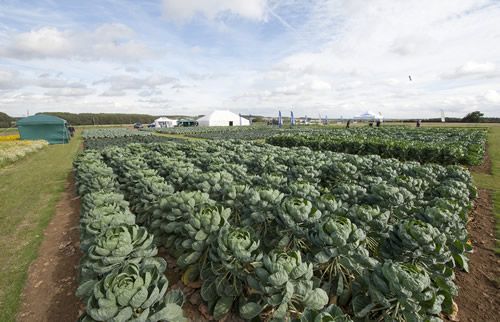
UK vegetable growers have been reassured that continued investment in R&D and product development will bring improved new varieties and crop protection solutions over the coming years, according to Syngenta UK Country Head, Gary Mills-Thomas. He reports the company has prioritised vegetable production as one of its key areas for investment, with exciting new opportunities already in development.
Speaking to growers and agronomists at the Syngenta Vegetable Agronomy Open Day last month, he highlighted that the company has now combined its Seeds and Crop Protection businesses in one unified operation. This has created greater emphasis in developing solutions for growers that incorporates genetic advances in plant breeding, with the agronomic techniques to get the best possible results in yield and quality.
’Syngenta invests around ’2m a day in global R&D. Now, from the creation of a new variety or the inception of a new crop protection product we will be looking at ways they can be dovetailed together, to get the optimum results from each,’ he said. ’That ’one-Syngenta’ approach will continue right through to the customer, with proven solutions to put into practice in the field.’
Mr Mills-Thomas added that the Syngenta UK vegetable business was also now allied to the company’s operations in the Nordic and Benelux countries. ’It means UK growers will immediately benefit from the huge investment and concentration on vegetable crops, especially the Benelux states. We now have a direct link into the dedicated R&D facilities at Enkhuizen, which will be developing products and solutions tailored to UK needs.’
New improved variety traits
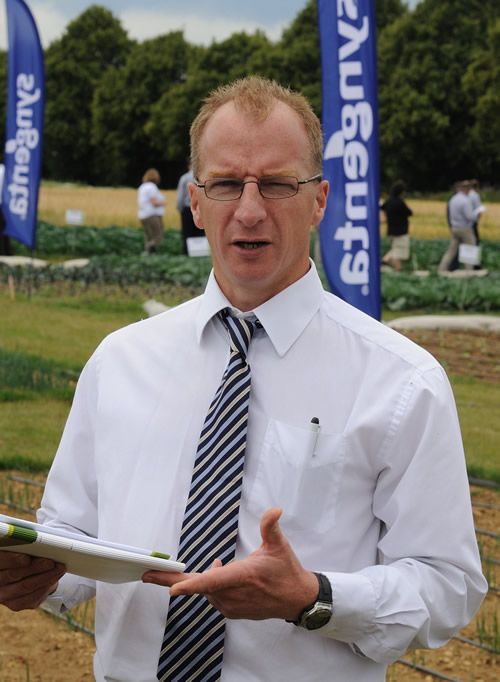
Syngenta brassica specialist, Mike Molyneux, highlighted the new strategy will create some innovative future developments for growers. At the growers’ Open Day, held at the PGRO near Peterborough, he highlighted the potential to breed in natural resistance to insect pests and bacterial rots, which is being developed in twin-track with consumer traits to offer growers improved varieties.
’Growers have already seen what we can achieve with genetic traits, such as our clubroot resistance introduced to an increasing range of brassica crops. The breeding programme has also seen huge advances in varieties with improved consumer characteristics in taste and storability, as well as agronomic traits to increase marketable yield and help better crop management in the field.’ In the short-term, he added variety specialists are addressing Light Leaf Spot susceptibility, which is increasingly being identified by growers as an issue from Scotland down into Lincolnshire.
Exciting new seed treatment on show
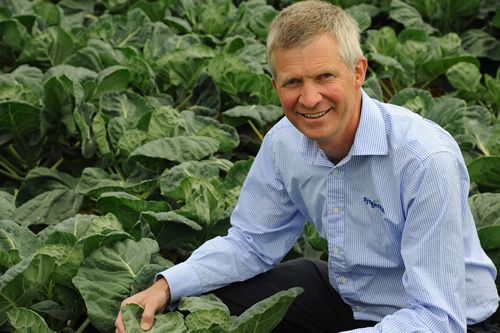
Michael Tait, Syngenta Technical Manager, also reported the company’s North European Territory will bring improved cross-country co-ordination of new product developments, building on the significant investments in Benelux. Thiamethoxam seed treatment, for example, has recently gained approval in Holland for most of the vegetable brassica crops and lettuce. ’It has a label approval there for Peach Potato Aphid and Mealy Cabbage Aphid, with field trials showing control lasting well in excess of the claimed six weeks. That gives really good potential for early season pest control and greater flexibility for the introduction of follow-up foliar spray programmes.’
Trials of the thiamethoxam seed treatment, available as treated dummy prills to plant alongside seed or with phytodrip technology application on block raised seedlings, were on show for the first time at the Open Day. Mr Tait reported that aphid pressure at the trail site had generally been low, but observation had shown an early reduction in initial whitefly build-up in the treated plots. Overall the thiamethoxam treated plots showed improved early season vigour and leaf quality.
Mr Tait also flagged up the valuable prospect of emamectin - a new foliar insecticide that may be available to fruit growers in 2012, and with potential for brassica vegetable crops soon after. In trials it has proven to be highly effective in controlling caterpillars, with the advantage of being far more targeted at these pests than pyrethroid sprays. Characteristics of the product include rapid degradation on the leaf, leading to the potential for shorter harvest intervals and making it a good fit with IPM systems and integration with biological controls, he added.
Other crop protection developments on show at the event included new fungicide programmes based on the Syngenta active, isopyrazam, which is being developed in vegetable crops after a successful launch into cereal crops. The inherently powerful activity of the unique SDHI fungicide molecule was shown to have a wide spectrum of activity on vegetable disease pathogens, and should prove to be a step forward for their control in a range of crops including brassicas and carrots, according to Syngenta Vegetable Technical Manager, Jon Ogborn.
He added that a further new development will see the availability of Revus for lettuce growers in 2012, offering the potential to significantly improve Downy Mildew control that can cause serious losses in the crop. However, Mr Ogborn advised growers will have to abide by stewardship guidelines for use in tank-mixes and sequences, until co-formulated mandipropamid products can be developed over subsequent years.
Testing nutrition
Vegetable and salad growers should be testing both soil and tissue to create better crop nutrition plans, advised Mark Tucker of Yara, co-sponsors of the Vegetable Agronomy Site. Soil analysis has shown that over 90% of soils are below optimum levels for sulphur and boron, for example, but tissue analysis suggests only 6% of plants are short of sulphur requirement and 47% short of boron, he reported. However, whist calcium almost never shows up as short in soil analysis, over 20% of plants show a deficiency in foliar analysis. With Magnesium, over 90% of plants tested were showing deficiency during growth, compared to 36% of deficient soils.
’We know that various trace elements play a crucial role in the agronomy and production of vegetable crops, influencing appearance, colour, taste and storability, as well as yield and susceptibility to diseases. They also influence the uptake and utilisation of other nutrients that are critical to plant health and vigour.
’Clearly it is vital growers know what is happening in their soil and in the growing plant to tailor nutrient plans more effectively and use the optimum inputs.’ Mr Tucker added that by using the appropriate Yara Crop Nutrition products growers can alleviate the effects of trace element deficiencies during cropping and are an essential part of Integrated Crop Management programmes.
’There’s great potential to use nutrients to enhance plant defence mechanisms,’ he said. Calcium and boron, for example, are essential for the integrity of the cell wall and cell turgor, which will help to naturally protect the plant from disease and damage. Molybdenum and sulphur has to be present during early stages of growth to enhance nitrate metabolism that will maintain healthy growth, but as the plant develops copper, iron and sulphur are required.




