




Keep one step ahead of Chocolate Spot
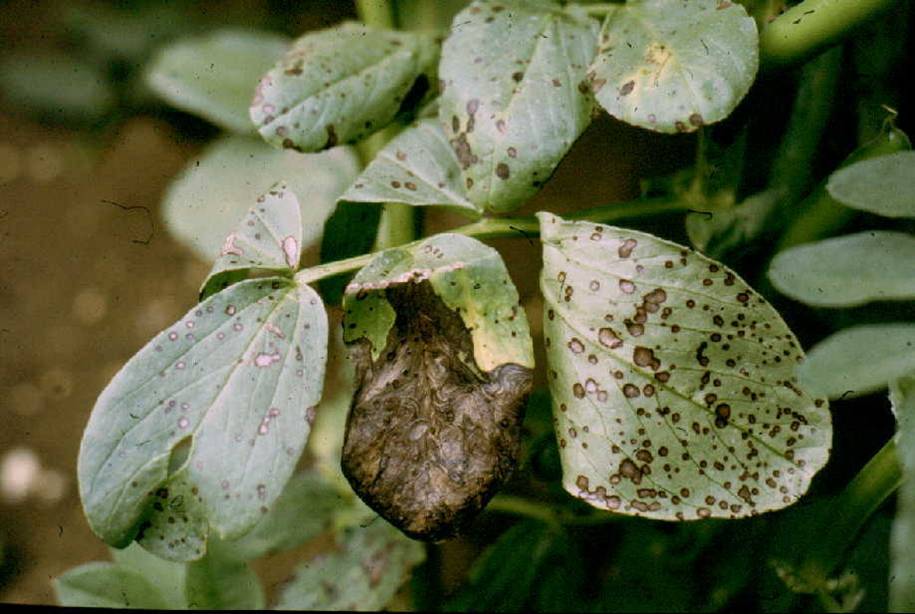
Growers of winter beans, particularly those who are new to growing the crop, are being reminded that they must keep well ahead of chocolate spot, as all effective fungicides are protectant in action and need to be applied before the disease is established.
Dr. Anthony Biddle, Technical Director of PGRO reports that the area of winter beans is up by around 36% this year and so there will be some growers who have not grown this crop before. "These new growers may not fully realise that diseases in beans must be prevented, rather than cured. Effective fungicides such as Signum are protectant in nature and need to be applied before the infection takes place. So it is important to keep a close eye on disease and be prepared to act quickly."
Dr. Biddle has been assessing the performance of a range of fungicides against both chocolate spot (Botrytis cinerea and B. fabae) and rust (Uromyces fabae) in beans. "Signum has worked very well on rusts and is as good as any of the best products on chocolate spot. It is a very useful product to use in a programme."
He advises that the first application of fungicide should be applied at early flowering stage, with the second application four weeks later.
"The first spray is usually applied at early flowering and targeted just at chocolate spot, with the second spray targeted at both chocolate spot and rusts. Winter bean crops this year are variable in terms of their growth, with some crops close to first flower bud and others just 4 inches high. It is the growth stage of the crops which should govern the first fungicide treatment, regardless of calendar date."
According to Jonathan Ball, BASF Peas and Beans Product Manager, growers should be gearing up to start their fungicide programme in beans. "Chocolate spot and rust can easily escalate to epidemic proportions, when conditions allow. Chocolate spot can escalate if it is warm and wet and if it stays warm, rusts could become a problem later on in June," he says.
"Signum has been a technical breakthrough in the protection against chocolate spot and rust. It offers superior performance and greater persistence compared to other protectant fungicides and is the first choice where disease pressure is high for both chocolate spot and rusts," says Jonathan.
"In trials, Signum gave 74% control of chocolate spot, outperforming other treatments, with its high performance being reflected in yields. In a TAG trial, Signum treatments yielded 3.58 t/ha compared with 2.75 t/ha for the untreated, equal to a yield increase of 0.8 t/ha."
"Chocolate spot is not an easy disease to control and resistance issues need to be considered, which is why it is useful to have a good choice of treatments and to integrate fungicides with different modes of action. With resistance management guidelines in mind, fungicides should be alternated with products from a different cross-resistance group. For example, a programme could start with Signum at T1 and be followed by Caramba at T2 if the threat from rust increases later in the season," advises Mr. Ball.
He points out that excellent control of chocolate spot and rust has also been obtained with Walabi applied at 1.5 l/ha as the early-flowering spray, followed by Signum (0.5 kg/ha) at late flowering. "Signum is the preferred choice in high or moderate risk situations due to its robust broad-spectrum activity, whilst a follow-up Walabi application can be used if disease risk remains low to moderate, or is declining."




