




Match oilseed variety to the field
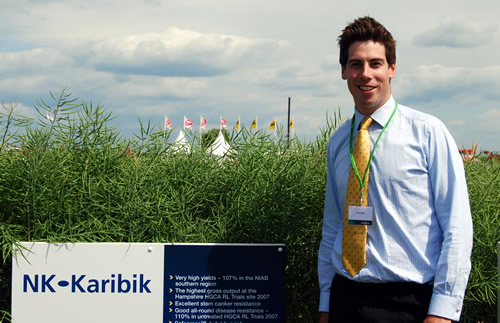
Matching oilseed rape varieties to soil type and local conditions in the south of England could significantly boost a crop's potential says OSR breeder NK.
When choosing a variety this autumn, NK's Will Miller recommends matching growth habit to soil type to maximise performance and possibly reduce inputs. "For example, growers on lighter land could see a significant advantage by opting to grow a hybrid variety," he says.
"The higher vigour and greater rooting ability of hybrids gives them an advantage in less fertile conditions. Initial results from independent trials suggest these factors may also be relevant when looking to reduce the amount of fertiliser applied to the crop."
As plant height is reduced on less fertile soil types, choosing the right variety should start with a simple assessment of the average height of OSR crops achieved on the farm. If they rarely reach 1.6 m, avoiding shorter conventional varieties and picking a hybrid could be the answer.
With a superb resistance to stem canker and good standing power, hybrid variety NK Karibik is proving its credentials in the south of England, scoring the highest gross output of any variety at the HGCA Recommended List Trials site in Hampshire in 2007 (113% of control) and the second highest across the NIAB southern region 2008 (107% of control).
Farm manager Philip Simmonds has 20ha of NK Karibik at Little Durnford Farms near Salisbury. As a first-time hybrid oilseed rape grower he was delighted when the crop established well in difficult conditions, coming through the spring very clean and free from any fungal disease.
"The variety has responded to the field conditions perfectly, it stood up well and looks to be delivering a greater yield when compared to my other crops. Checking pod numbers, size and seeds per pod against my crop of Lioness: NK Karibik has on average 65 pods on a raceme, each pod containing around 14 seeds; Lioness as 40 pods, each containing 10 seeds," says Philip. He is so pleased with the crop he has already ordered 52.5 ha of NK Karibik for autumn 08 drilling.
Will believes NK Karibik's success in the south is due to two key factors: the variety's hybrid vigour, which gives it an advantage in less than ideal conditions; and its disease resistance, which makes it ideally suited for the southern counties.
"In lighter, less fertile or dry land situations where plant height is naturally reduced, higher biomass varieties like NK Karibik are better able to exploit the limited resources available. This makes them more competitive and they subsequently outperform other varieties at these sites," says Will Miller.




