




The low biomass rape, Es Astrid offers greater profit opportunities
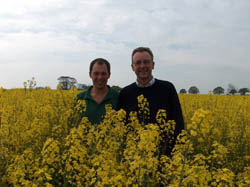
The professional farming company, Sentry Ltd who farm 18,000 hectares across the UK are always looking at ways of managing their crops carefully and more cost- effectively in order to produce high and consistent yields thereby achieving positive operational margins. Oilseed rape has shown variable profit margins in the past but with improved pricing, better yielding varieties and low biomass varieties such as Es Astrid where the use of inputs can be optimised, margins are looking more optimistic," says John Barrett and Richard Peck, Farm Business Managers for Sentry Ltd.
"At Sentry our objective is to deliver added value and to create profits. We do this by constant attention to detail and analysis of all aspects of crop management. Take oilseed rape as an example. Several years ago I questioned the viability of growing rape, but at £165 to 170/tonne it can be profitable, providing growing costs are controlled and consistent and high yields are achieved," says Farm Business Manager, Richard Peck.
Richard explains that Sentry's benchmarking system showed that in 2006 the top 25% of their growers were achieving rape yields of 3.8 t/ha at a growing cost of £132/tonne. "This was broken down into £55/tonne for operations, £23/tonne for fertiliser, £23/tonne for agrochemicals, £22/tonne for general and sundries and £9/tonne for seed. The bottom 25% however were achieving 2.7 t/ha at a growing cost of £200/tonne. This analysis demonstrates that there is scope to increase yield and control costs effectively," explains Richard.
"But you need to be growing the right varieties in the right way. The introduction of low biomass varieties such as Es Astrid have lead to more consistent, higher yields and plenty of opportunities to minimise input costs, all of which add up to greater margins," says Mr. Peck.
John Barrett, also a Farm Business Manager for Sentry Ltd. and responsible for contract farming 1,680 hectares in East Anglia on behalf of five landowners, agrees with his colleague and adds that every crop he grows must stand on its own two-feet when it comes to margin generation. "That is why my focus is on those crops that produce high outputs using lower inputs and hence result in positive operational margins."
"We start by looking very carefully at each individual crops' yield potential as a measure of its output and, when it comes to yield, it is the conventional low biomass oilseed rape varieties, such as Es Astrid, that deliver the most consistent and the highest seed yields. I believe that Es Astrid had one of the highest seed yield on the HGCA list this year. In East Anglia alone it had the highest yielding with 105.2%. On our soils I am budgeting to achieve at least 1.5 tonnes/acre (3.75 t/ha) with Astrid this year," he says.
According to John, Astrid not only yields well but it also allows some inputs to be minimised and hence savings to be made. "Astrid has excellent straw stiffness and high resistance to lodging, making it much easier and less costly to manage. The effect of lodging in rape is often under estimated as it can have a significant impact on yield and slows down a number of operations. The shortness of Astrid also allows the crop to be direct combined by our own machinery and labour. Being able to harvest the crop faster and more efficiently will reduce machinery and fuel costs. It would also be more expensive to bring in an outside contractor."
"Having intrinsically high and stable resistance to Phoma stem canker, Astrid could also, in some instances, obviate the need for one treatment in a fungicide programme or at least allow a less robust and cheaper programme to be used, with no detrimental effects on yields. It also allows more flexible timing of the fungicide as delays in timing will be less critical," says Mr. Barrett. Richard Peck endorses this as in the South of England it was virtually impossible last winter to apply any fungicide between October and February as it was too wet, but a Phoma spray was applied in February.
The result of this approach will be analysed along with the results of a large-scale programme laid down this year to look at increasing yields and reducing input costs. In conjunction with partners Agrovista, Sentry are trialling low and high input systems for disease and plant growth regulation at the four sites across the UK. With Simba, Sentry are also focusing on ways of improving establishment, but at a reduced cost.
"It is important for the bottom line to grow oilseed rape with attention to detail from establishment right through to harvest, but wherever and when ever savings can be made without affecting yield they should be made. The conventional high yielding low biomass variety Astrid is one of the key rape varieties that has a high seed yield and opportunities to lower operating costs, thereby help us achieve our profit objectives," says John Barrett.
"Es Astrid has become a one of the most widely grown winter oilseed rape varieties, as it is the highest yielding variety when it comes to seed yield on the HGCA Recommended List. It also shows great yield stability, meaning that however it is established or wherever it is grown, it performs well. In addition it is the only conventional variety with a consistent and stable eight rating for resistance to Phoma stem canker (on a scale of 1-9 where 9 is the top rating you can achieve.) It also has an eight rating for resistance to lodging, an eight rating for shortness of stem and an eight rating for stem stiffness, This all adds up to a high performing, reliable rape variety that is easier and more cost-effective to manage," adds Grainseed Director, John Hardy.




