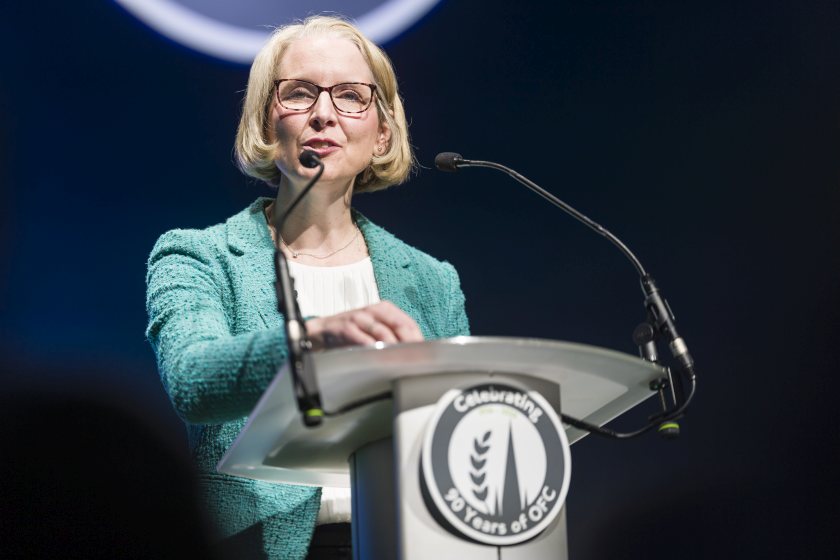
The government set out changes to inheritance tax, environmental schemes and farm funding as the Defra Secretary addressed the Oxford Farming Conference.
Emma Reynolds used her first speech at the event to outline a shift in the relationship between government and agriculture, which she said would be focused on clarity, stability and long-term growth.
Speaking in Oxford on Thursday (8 January), she said farmers are “at the heart of our national life”, managing 70% of England’s land and producing 65% of the food the country eats.
Reynolds said her early months in the role had been shaped by discussions with the NFU and industry stakeholders, which she said had deepened her respect for farmers’ resilience and innovation.
She also thanked farmers who supported their communities during recent snowfall, praising those who cleared roads and helped protect local residents.
The speech included changes to the government's controversial inheritance tax proposals unveiled before Christmas, following strong concern from farmers over the impact on small and medium-sized family businesses.
Reynolds said the government will raise the threshold for agricultural property relief and business property relief from £1m to £2.5m, allowing couples to pass on up to £5m without paying inheritance tax on qualifying assets.
She said around 85% of estates claiming APR, including those also claiming BPR, will now pay no more inheritance tax, adding: “Good governments listen.” She said no further changes were planned.
Responding to the speech, NFU president Tom Bradshaw said it was “encouraging to see the Defra Secretary of State’s real ambition for a thriving agriculture industry”.
He welcomed the commitment to working collaboratively with farmers and growers, saying policies that support productivity and growth remain essential.
Reynolds also confirmed plans to establish a new Farming and Food Partnership Board, bringing together farmers, processors, retailers and finance to shape policy across the food system.
She said farmers would have “a seat at the table” as policy is developed, stressing that food security depends on collaboration across the supply chain.
Sector growth plans will begin with horticulture and poultry, followed by other parts of the industry where domestic production can be expanded.
The Defra Secretary said the government will also pursue planning reform to unlock food and farming infrastructure, step up action on supply chain fairness, support private investment and expand trade missions for British food and drink.
She announced a new £30m Farmer Collaboration Fund over three years to help farmers share knowledge, improve productivity and collaborate on environmental outcomes.
Addressing environmental schemes, Reynolds acknowledged frustration with the Sustainable Farming Incentive, saying it had become too complex and that last year’s unexpected closure damaged trust.
She said the government will simplify the scheme, improve fairness by addressing the concentration of funding among larger farms, and provide greater certainty and transparency.
Two SFI application windows will open this year, with an initial window from June for small farms and those without existing agreements, followed by a second window from September for all farms.
Reynolds said full scheme details and budgets will be published in advance, with “no more sudden unexpected closures”, adding that the scheme’s core design would be stabilised for the rest of the parliament.
Bradshaw said he was pleased to hear the Secretary of State speak about “much-needed clarity” ahead of each Sustainable Farming Incentive payment window.
“Farming is a long-term investment, measured in years, not months,” he said, adding that clarity and transparency around the farming budget are critical for confidence and business planning.
Bradshaw said important questions remain around delivery, including the 25-year Farming Roadmap and the rollout of the Farming Profitability Review.
“We want to work with government to drive these policies forward to create confidence and profitability for farming and growing businesses,” he said.
NFU deputy president David Exwood welcomed plans to reform the SFI and the commitment to work collaboratively with farmers, particularly in uplands and protected landscapes.
But he warned there remains “a huge lack of detail that farmers and growers urgently need”, adding that uncertainty continues to undermine confidence and investment.
Exwood said the NFU recognises the farming budget is finite and that funding must be spread more evenly, but stressed that SFI must remain accessible to all food-producing businesses. He said that if a funding cap is introduced, the NFU supports a cap per hectare for SFI agreements.
He also highlighted concern over the number of existing agri-environment agreements due to expire, with around 27,800 farmers expected to reach the end of their schemes by the close of the 2026–27 financial year.
With that deadline approaching, he said it is “essential” farmers receive clarity on SFI budgets for the two application windows to ensure continuity of environmental delivery.
The announcements come amid growing pressure on ministers to restore confidence following disruption to farm support schemes last year.
Industry leaders said farmers will now be looking for swift detail and delivery, warning that confidence will depend on whether clarity follows quickly.