

Volatility, TB and regulation threaten dairy growth, industry leaders say

British dairy’s future hangs on fair contracts, stable regulation and decisive government action, NFU leaders have warned, as farmers grapple with volatility, labour shortages and mounting disease pressure.
Speaking at the NFU Conference, Dairy Board chair Paul Tompkins set out a stark challenge to government and supply chain partners, arguing that confidence to invest will only return if structural problems are addressed.
Rather than reflecting on the outgoing board’s two-year term, he focused firmly on what must change to secure the sector’s long-term prosperity.
He said price volatility and uncertainty over milk volumes were making it difficult for farmers to commit to buildings, herd expansion and borrowing, while rising costs linked to potential environmental permitting rules were already discouraging investment and forcing some producers to exit the industry.
The intervention comes as tight margins and policy uncertainty continue to weigh heavily on dairy businesses, with succession concerns and workforce shortages adding to the strain on family farms.
Tompkins also questioned whether fair dealing reforms were truly reshaping behaviour in the supply chain, pointing to contracts and practices that remain inconsistent with the regulations.
He stressed that trade negotiations must continue to advance UK dairy exports without undermining domestic standards.
Bovine TB remains another major concern. Tompkins criticised the policy vacuum following the government’s decision to end wildlife control, describing the situation as “completely unforgivable” given the economic and emotional toll the disease imposes on farming families.
From government, the sector is seeking a stable, long-term regulatory and investment framework, alongside support for an industry-led alternative to environmental permitting.
Tompkins called for trade deals that expand export opportunities, stronger fair-dealing rules and extended powers for the Agriculture Supply Chain Adjudicator to investigate contractual compliance.
He also urged ministers to publish a refreshed TB strategy that gives farmers and vets greater control over tackling infection within herds.
Processors and retailers, meanwhile, were urged to build “honest partnership[s]” with producers through transparent contracts, clearer volume signals and a willingness to share both risk and reward.
Tompkins encouraged farmers themselves to collaborate more closely on purchasing, marketing, labour and investment.
“This is a tough time, but the fundamentals are still on our side. People will keep consuming dairy,” he said. The UK’s “diverse range of systems, climate, skills and standards gives us a strong platform”.
He added that with the right framework on regulation, trade and supply chain practice, British dairy “has every reason to be confident about the future”.
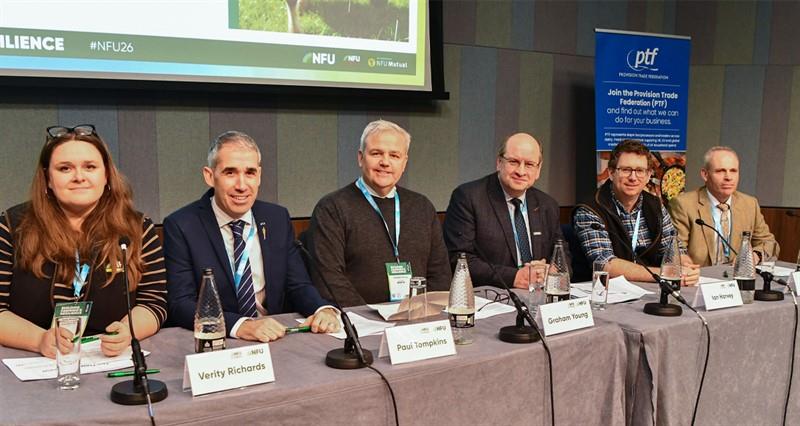
A panel featuring regional board chairs Ian Harvey, Rob Davies, Matt Ford and Graham Young reinforced concerns over milk oversupply, contract fairness, AHDB marketing priorities and the fragility of just-in-time supply chains.
TB and the search for alternatives to the badger cull also dominated discussion, with speakers stressing the need for policy to keep pace with emerging scientific solutions.
Environmental permitting proposals prompted lively debate. Davies questioned whether the approach would deliver better outcomes than innovations such as nutrient-stripping technologies.
Environment Agency chair Alan Lovell told delegates any system applied to dairy and livestock would be selective and designed to reward good performance, operating differently from existing rules in the pig and poultry sectors.
He suggested “there would be no need to go there if we could develop an industry initiative that would achieve the same results”, but warned that progress must be swift.
Tompkins acknowledged dairy’s role in reducing pollution, noting measurement differs from other sectors and “there was some nuance in those numbers”.
He welcomed the possibility that permitting might not be universally imposed, adding that collaboration could deliver an effective alternative.
Whether that alternative emerges — and how quickly policy clarity follows — may prove decisive in determining whether British dairy enters its next phase with renewed confidence or continued uncertainty.