

MPs warn solar farms are putting Britain's best farmland at risk
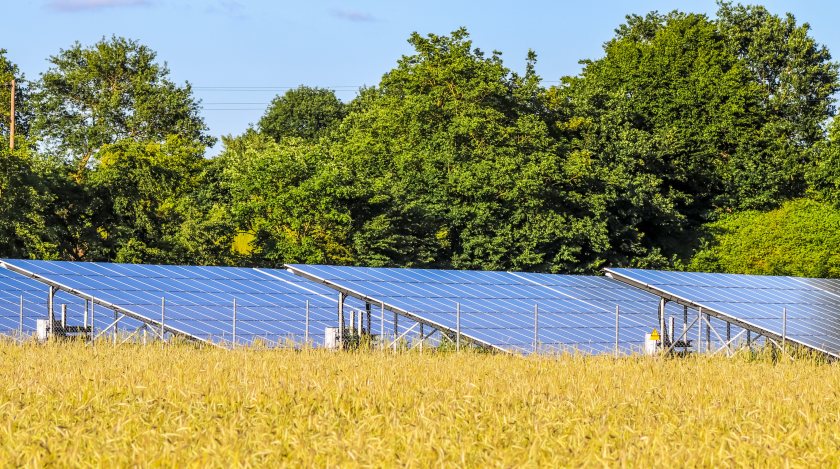
MPs have warned that Britain's best farmland is being put at risk by large-scale solar developments, as ministers face mounting pressure to protect food production.
Conservative MP Esther McVey challenged ministers during a Westminster Hall debate on Tuesday (3 November), highlighting plans for a 150-acre development at Tabley Hill in Cheshire that includes 70 acres of grade 1 agricultural land.
She warned that the project could remove valuable farmland from conventional food production for up to 40 years, arguing that solar developments should prioritise brownfield sites, rooftops and lower-quality land.
"Productive farmland should be protected wherever possible," she told MPs.
McVey acknowledged the financial pressures facing British farmers and the appeal of securing long-term income from solar developments.
However, she argued that planning policies should not make electricity generation more attractive than food production on some of the country's highest-quality farmland.
She also raised concerns about tenant farmers potentially losing access to land and rising land values making it harder for new entrants to establish agricultural businesses.
The debate highlighted the growing scale of solar development across Britain.
Citing House of Commons Library research, McVey said 733 solar photovoltaic projects received planning permission across the UK between August 2025 and July 2026.
She also claimed that around 188,000 acres had been approved for grid-scale solar developments nationwide.
Other MPs raised similar concerns about projects in their constituencies, including developments in Kent and Northamptonshire.
Conservative MP Helen Whately highlighted an existing solar development covering more than 700 acres in her Faversham and Mid Kent constituency, alongside a recently approved 160-acre scheme near Rodmersham.
Meanwhile, South Northamptonshire MP Sarah Bool criticised the approval of the Green Hill solar farm, saying 60% of the development would occupy the best and most versatile agricultural land.
She warned that conventional arable production could be restricted for up to 60 years, with local campaigners considering a judicial review.
Green Party MP Adrian Ramsay also called for a more coordinated approach to solar expansion, arguing that renewable energy, food production and nature recovery must be considered together.
Responding to the concerns, energy minister Michael Shanks defended solar power as essential for strengthening Britain's energy security and reducing reliance on fossil fuels.
He said solar remained one of the cheapest forms of electricity generation and would play an important role in keeping energy costs down.
Shanks told MPs that solar farms occupied approximately 21,000 hectares at the end of September 2024, representing around 0.1% of the UK's total land area.
He stressed that this was a relatively small national footprint, while acknowledging that individual developments could have significant local impacts.
"Food security is national security," he told MPs, emphasising the importance of supporting British agriculture.
The minister maintained that existing planning rules already encouraged developers to prioritise brownfield sites and lower-grade agricultural land.
He also referred to the National Farmers' Union, saying the organisation had previously indicated that solar development did not pose a threat to national food security.
However, MPs questioned whether current safeguards were being applied effectively when large developments continued to receive approval on productive farmland.
Shanks highlighted opportunities for agriculture and solar generation to operate alongside one another, including livestock grazing beneath panels and emerging agrivoltaic technologies.
Bool challenged whether such arrangements could be guaranteed, arguing that proposed agricultural benefits were not always accepted as part of planning decisions.
The minister acknowledged that combining farming and solar generation would not be possible in every case, but said successful examples already existed.
McVey pressed the government to strengthen planning protections for prime agricultural land and address the cumulative impact of solar developments.
However, Shanks stopped short of announcing tighter restrictions, maintaining that existing rules already considered food security, environmental impacts and local concerns.
He said further reforms remained possible but insisted that ground-mounted solar would continue to play an important role in Britain's energy transition.
The debate leaves unresolved questions over whether current planning safeguards can adequately protect productive farmland while supporting the expansion of renewable electricity.